

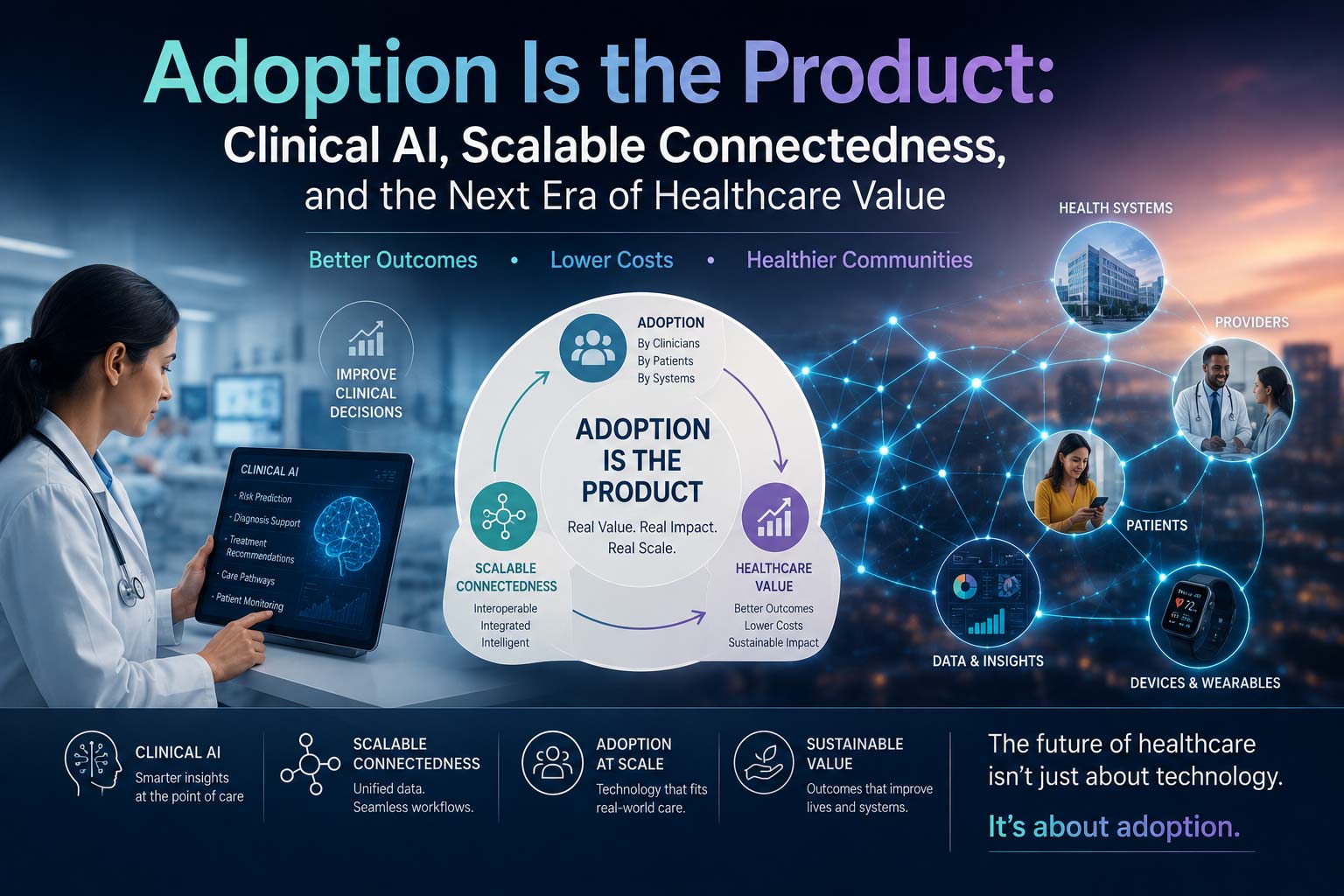
In clinical AI, progress is easy to signal and difficult to achieve. A model is validated. A pilot launches. A press release announces state-of-the-art performance. From the outside, it looks like momentum. Inside the hospital, the clinician works within the same constraints, the workflow carries the same load, and the patient experiences no difference. The model exists; adoption does not. That distance, the space between what an algorithm can do in validation and what it changes in care, is the central economic fact of healthcare AI, and almost no one is pricing it correctly.
The evidence describes a field investing in capability and waiting on impact. According to Rock Health, U.S. digital health funding reached $14.2 billion in 2025, up 35% over the prior year, with companies centering AI capturing 54% of it, up from 37% a year earlier. Yet a 2025 McKinsey survey found that only about 39% of organizations report any enterprise-level earnings impact from AI, and most of that impact is under 5%. Capital is flowing toward model capability while the return on it lags. The constraint is rarely model quality; less than 60% of the data healthcare organizations already generate is used in decision-making. The capacity to build models has outrun the capacity to absorb them, and almost no one is pricing that gap correctly.
Why AI Widens the Distance
AI does not close the gap between science and care by default; in important ways it widens it. Predictive models are extrapolation engines: they describe risk well and rarely change it, because a probability is not an intervention. Convergence AI, the merging of once-separate fields (biology, imaging, language, and clinical data) into systems that reason across all of them at once, compounds discovery faster than any prior wave of healthcare technology, and faster than delivery systems can absorb. Generative medicine, in which AI designs novel therapeutics and interventions on demand rather than merely predicting risk, is the sharpest current expression of that acceleration. Each advance enlarges the same distance: capability races ahead, and adoption waits.
The failure is specific, not vague. Models that perform in validation degrade in live clinical settings: distribution shift as local populations diverge from training data, workflow mismatch when an output arrives at the wrong moment in care, alert fatigue that turns signal into noise, and an integration burden that no benchmark measures. The pattern is documented. A widely deployed proprietary sepsis prediction model, live in hundreds of U.S. hospitals, was found on external validation to identify only about a third of sepsis cases while generating enough false alerts to fatigue the clinicians it was meant to help (Wong et al., JAMA Internal Medicine, 2021). The tool was not absurd; it simply did not survive contact with a real ward. Dentistry shows the same shape: AI that reliably flags caries or bone loss on a radiograph still changes nothing if it arrives outside the moment the clinician decides on treatment. A model can be accurate and still go unused, and an unused model changes nothing.
The contrast proves the point. A different sepsis system, deployed across five hospitals and monitoring more than 590,000 patients, was studied prospectively and reported in Nature Medicine in 2022. Among septic patients whose alert a clinician confirmed within three hours, in hospital mortality fell by roughly 18% (Henry et al., Nature Medicine, 2022). What separated this result from the failures was not a more brilliant algorithm; it was that the system earned sustained clinician use, near 89%, by fitting the way care already moved. The benefit tracked the adoption, not merely the prediction. Same disease, two models, opposite outcomes, and the difference lived in everything around the model rather than in the model itself.
This is why benchmark performance has become a poor predictor of clinical impact, and why the hard problem in healthcare AI has migrated from the model to everything around it.
The Thesis: Scalable Connectedness
This is the space I have spent my career studying, and it is the foundation of how I invest. I call it scalable connectedness. The premise is simple: science is accelerating faster than accessibility, and AI is the accelerant. The distance between what a model can do and what reaches the people who need it is widening, not closing. Most treat that distance as a gap to be lamented. I treat it as among the most underpriced spaces in healthcare AI, because it is where category-defining companies are built. Durable value does not come from a better model. It comes from connecting model capability to clinical adoption at scale.
That reframing changes what a strong AI company looks like and what a disciplined investor should underwrite. The defensible asset is not the algorithm; algorithms are increasingly abundant and quickly matched. The defensible asset is the ability to carry a model across the last and hardest distance, into a workflow, a reimbursement pathway, a clinician’s daily habit, a patient’s actual life. In clinical AI, the product is not the model. The product is the behavior change the model makes possible inside the system.
The Adoption Test
If adoption is the product, then adoption is where diligence should concentrate. The question that predicts outcomes is not “is the model accurate?” Most models are accurate in a demo. Three questions matter more:
- What specific clinical behavior has to change for this model to be used?
- Who owns that change, and do they have the authority and the incentive to see it through?
- Once the change is made, is it durable, or does it reverse the moment attention moves elsewhere?
A team that can answer those three is solving the problem that actually separates the clinical-AI winners from the graveyard of accurate, well-funded models that no one adopted.
Three Audiences, One Direction
This thesis speaks differently to the three groups building healthcare AI, but it points them the same way. For those allocating capital, durable returns favor the work that moves a model into care (the integration, the workflow, the trust) over the one-time benchmark win that never travels. For founders, the most defensible position is the one closest to the patient: owning the distance between what a model can compute and what a clinician can act on. For physician innovators, the clinical vantage point is not a detour from the work. It is a design advantage, because knowing exactly where care breaks down is knowing exactly where a model can create value.
And it answers a question I am asked often: whether purpose and return are at odds. They are not. The companies that move AI from capability to bedside are, in the same motion, the ones that compound. Dignity delivered at scale and durable financial performance are not competing objectives in this field. They are one objective seen from two sides.
Conclusion
Healthcare’s next era will not be defined by who builds the most capable model. It will be defined by who connects model capability to the people it was meant to serve. That is an engineering problem, an investment problem, and, for those of us who came to this work from medicine, a moral one. The space between what AI can compute and what care can use is not empty. It is where the future of healthcare value will be built, by the founders and the funds willing to treat connectedness itself as the thing worth building.
About the author
 Mohammed Quadri, MD, MBA, is a physician Enterpreneur, investor, and healthcare strategist focused on clinical AI, biotech, and life sciences from innovation through adoption. His work centers on scalable connectedness: the principle that durable value comes from connecting invention to adoption at scale, where purpose and returns advance together.