
THE GLOBAL SUMMITS INSTITUTE CHARTER
The #DoctortoDoctor Movement
Know More
PREAMBLE
For millennia, healthcare functioned as a direct ethical covenant between doctor and patient. In the past five decades, this covenant has been disrupted by non-clinical third parties, distorting incentives, eroding autonomy, and inflating costs. The Global Summits Institute exists to restore professional sovereignty by returning authority to doctors.
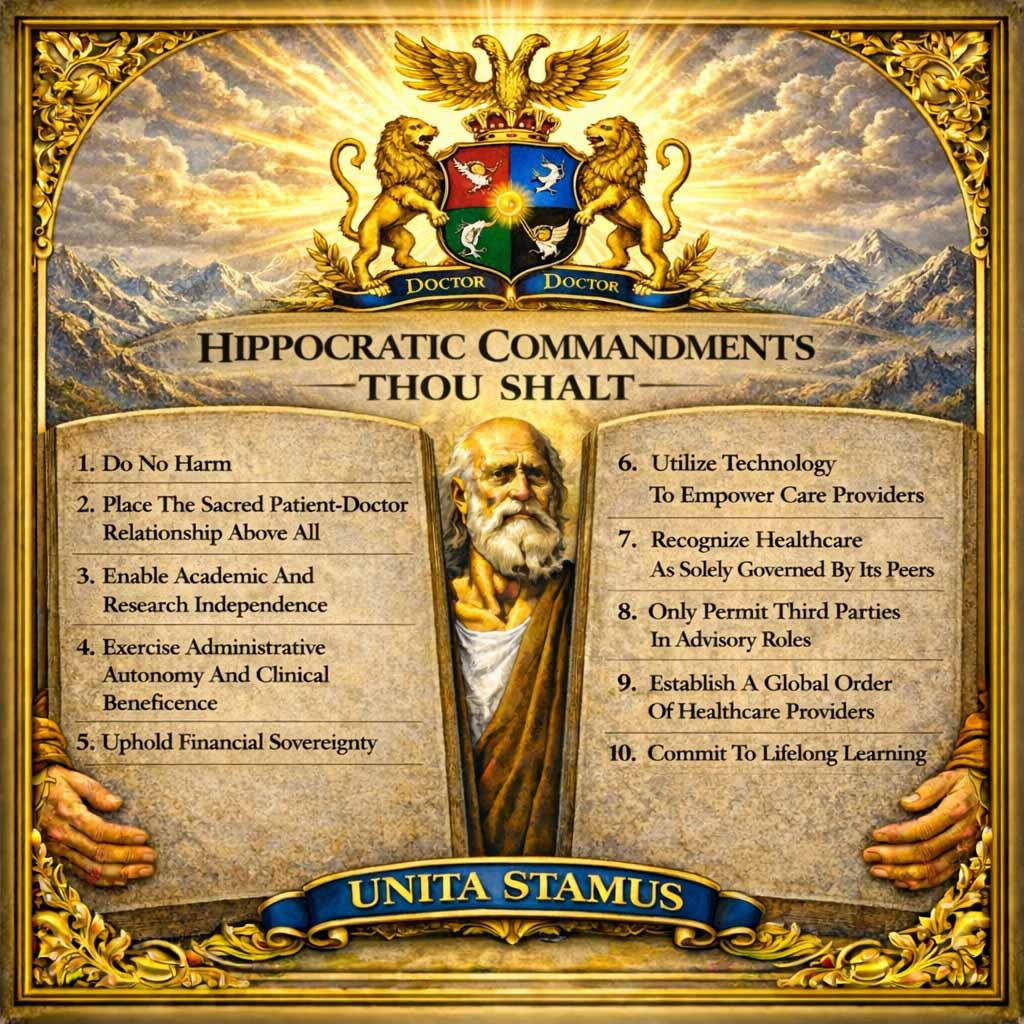
HIPPOCRATIC COMMANDEMENTS
I Thou shall Do No Harm
II Thou shall Place The Sacred Patient-Doctor Relationship Above All
III Thou shall Enable Academic and Research Independence
IV Thou shall Exercise Administrative Autonomy and Clinical Beneficence
V Thou shall Uphold Financial Sovereignty
VI Thou shall Utilize Technology to Empower Care Providers
VII Thou shall Recognize Healthcare As Solely Governed By Its Peers
VIII Thou shall Only Permit Third Parties in Advisory Roles
IX Thou shall Establish a Global Order of Healthcare Providers
X Thou shall Commit to Lifelong Learning
ARTICLE I – FOUNDATIONAL PRINCIPLE
Healthcare is a profession governed by its peers. Any individual or entity without formal healthcare education shall not hold any authority or control over healthcare management, delivery, or any aspect of its supply chain.
ARTICLE II – DOCTOR–PATIENT SOVEREIGNTY
The doctor–patient relationship is inviolable. No third party may supersede clinical judgment. All systems must serve this relationship.
ARTICLE III – THE THIRD-PARTY FALLACY
Third-party solutions introduced over the last five decades have become the primary problems of healthcare. With AI and modern technologies, most intermediary services can be replaced at a fraction of the cost, unlocking massive surplus resources.
ARTICLE IV – ROLE OF NON-DOCTOR PARTIES
Non-doctor professionals may serve only in advisory, fee-for-service roles with no ownership, authority, voting rights, or influence over clinical standards or governance.
ARTICLE V – TECHNOLOGY AS RESTORATION
Technology must empower doctors and patients, eliminate administrative burden, and restore autonomy. AI shall never supersede clinical judgment.
ARTICLE VI – THREE-PRONGED DOCTOR-LED SYSTEM
- Academic Sovereignty: Doctors define standards and ethics.
- Administrative Sovereignty: Doctors govern operations and policy.
- Financial Sovereignty: Doctors control capital and infrastructure.
ARTICLE VII – FAILURE OF LEGACY INSTITUTIONS
Legacy accreditation bodies and governments have failed to keep pace with modern healthcare realities. New ideas require new governance.
ARTICLE VIII – GLOBAL DOCTOR-LED OVERSIGHT
A global doctor-governed body shall define standards, accreditation, regulation, AI ethics, advocacy, and policy across specialties and regions.
ARTICLE IX – LEADERSHIP
Doctor leaders are elected through peer recognition across the healthcare supply chain in over 160 countries.
ARTICLE X – CONTINUING EDUCATION
Continuing education is the engine of change, uniting doctors globally in academic, administrative, and financial collaboration free of third-party influence.
DECLARATION
Doctors must lead healthcare. Technology must serve clinicians. Patients must come first.
This Charter restores the Hippocratic order for the 21st century.
THE HIPPOCRATIC COMMANDMENTS
A Manifesto for the Future of Healthcare
Know More
THOU SHALT uphold the sacred calling of medicine, not as an industry, not as a commodity, and not as a political instrument—but as a moral vocation entrusted to healthcare providers by humanity itself.
Medicine exists to heal, to protect dignity, and to serve life. Its authority is derived not from corporations, governments, or intermediaries, but from knowledge, ethics, and the enduring covenant between healthcare provider and patient.
I. Do No Harm
Medicine begins and ends with the primacy of non-maleficence. No policy, profit, ideology, or convenience shall supersede the obligation to protect patients from harm.
II. Place the Sacred Patient–Healthcare Provider Relationship Above All
The patient–healthcare provider relationship is inviolable. Trust, confidentiality, and clinical judgment form the cornerstone of care and must never be subordinated to external interests.
III. Enable Academic and Research Independence
Scientific inquiry must remain free from coercion, censorship, and financial distortion. Truth advances only when research is independent and debate is protected.
IV. Exercise Administrative Autonomy and Clinical Beneficence
Healthcare providers must retain authority over clinical decisions and practice management, ensuring that care is guided by beneficence rather than bureaucracy.
V. Uphold Financial Sovereignty
Healthcare providers shall control the economic framework of their labor, free from exploitative structures that compromise judgment, access, or outcomes.
VI. Utilize Technology to Empower Care Providers
Technology shall serve clinicians and patients—not replace judgment, extract value, or centralize control. Innovation must enhance care, efficiency, and human connection.
VII. Recognize Healthcare as Solely Governed by Its Peers
Healthcare shall be governed by qualified professionals within the field. Standards, ethics, and accountability must arise from those who practice healthcare.
VIII. Only Permit Third Parties in Advisory Roles
Non-clinical entities may advise, but shall never own, govern, direct, or vote on medical decisions. Authority resides with healthcare providers alone.
IX. Establish a Global Order of Healthcare Providers
A unified, healthcare provider-led global body shall set standards, coordinate ethics, advance collaboration, and safeguard healthcare for all humanity.
X. Commit to Lifelong Learning
Healthcare demands perpetual education. Healthcare providers shall continually refine knowledge, skills, and wisdom in service of evolving science and patient care.
These Commandments are not aspirational—they are foundational. They define healthcare as a moral profession, guided by science, protected by ethics, and accountable to patients above all else.
UNITA STAMUS
United, we stand—for healthcare, for patients, and for the future of medicine.
Story of Our Coat Of Arms
A Symbol of Unity, Wisdom, and Strength
Know More
 At the heart of our identity stands our crest, a timeless emblem that tells the story of who we are and what we stand for as Doctors.
The animals within the shield are not chosen for ornament, but for meaning.
The lions stand as the kings of the land, embodying courage, leadership, and unwavering strength. They represent Doctors who stand boldly at the forefront, protecting the health and dignity of those they serve.
The owls, queens of the night, symbolize wisdom, vigilance, and insight. They reflect the deep knowledge, discernment, and thoughtful judgment that guide every decision made in the quiet hours when clarity matters most.
The soaring eagles, masters of the sky, rise above all obstacles. With keen vision and decisive power, they represent Doctors who see beyond self-serving interests, crushing corruption and injustice to defend the greater good.
The dolphins, the most intelligent beings of the oceans, signify collaboration, compassion, and advanced understanding. They embody the brilliance, adaptability, and collective intelligence required to navigate the ever-changing waters of modern medicine.
Together, these guardians of land, sea, and sky form a unified force—each discipline, each voice, each strength converging into one purpose.
At the center of the crest lies a radiant point of light—the convergence of all paths. This light represents hope, clarity, and a bright future ahead. It is the light at the end of the tunnel, born from unity, integrity, and shared purpose. Every act of courage, wisdom, vision, and intelligence feeds into this center, illuminating the way forward for the profession and for those we serve.
Beneath the shield is our foundation: “Unita Stamus”—United We Stand. Below it, in Greek, the enduring truth: “Divided We Fall.” These words are not merely a motto; they are a call to action.
When Doctors come together across disciplines—medicine, pharmacy, dentistry, philosophy, optometry, chiropractic, and beyond—we become unstoppable. United by purpose, guided by wisdom, and driven by integrity, there is no force that can stand against us.
This crest is our declaration:
Together, we rise. Together, we stand. Together, we light the future.