Every dentist knows the feeling: staring at a bitewing, squinting at a shadow, wondering is that early caries, or just an artifact? For decades, radiograph interpretation has relied entirely on the human eye. But today, artificial intelligence is stepping in as a powerful second set of eyes, helping dental teams detect what might otherwise be missed.
The diagnostic challenge
Studies consistently show that up to one-third of dental pathologies are difficult to detect visually on traditional X-rays. Subtle interproximal caries, early periapical changes, and fractures can evade even experienced clinicians — especially during a packed schedule when a dentist may review dozens of radiographs in a single day.
The consequences are real: missed findings lead to delayed treatment, more invasive procedures down the line, and erosion of patient trust. For insurance-driven practices, undocumented pathology also means lost revenue from claims that could have been substantiated.
How AI changes the game
Modern dental AI platforms analyze digital radiographs — bitewings, periapicals, and panoramic images — in seconds. Using deep learning algorithms trained on millions of annotated images, these systems highlight areas of concern with remarkable precision.
VELMENI is a modern dental AI software that helps analyze bitewing, periapical, panoramic as well as CBCT X-rays and instantly provides analysis through its robust AI models.
Let’s talk about the CHALLENGES faced in a dental office and how AI helps the dental team.
Challenge 1: Reducing missed diagnoses in high-volume dental practices
In a busy dental practice, early or incipient caries can be difficult to detect on radiographs, increasing the risk of missed diagnoses. Even when dentists identify these lesions, explaining subtle findings on traditional black-and-gray X-rays can be challenging.
From the patient’s perspective, understanding radiographs is often difficult. Dentists may spend 20–30 minutes explaining findings, yet patients may still struggle to visualize the problem, leading to delayed treatment acceptance.
The AI solution
For dentists:
VELMENI’s AI analyzes radiographs within seconds as soon as they are captured in an imaging software and highlights potential areas of concern, such as incipient caries, providing a reliable second set of eyes and improving diagnostic confidence (Figure 1).
For patients:
VELMENI visually highlights dental conditions directly on the X-ray, making findings easier to understand. This improves patient education, reduces consultation time, and helps patients make treatment decisions with greater confidence.
Fig. 1
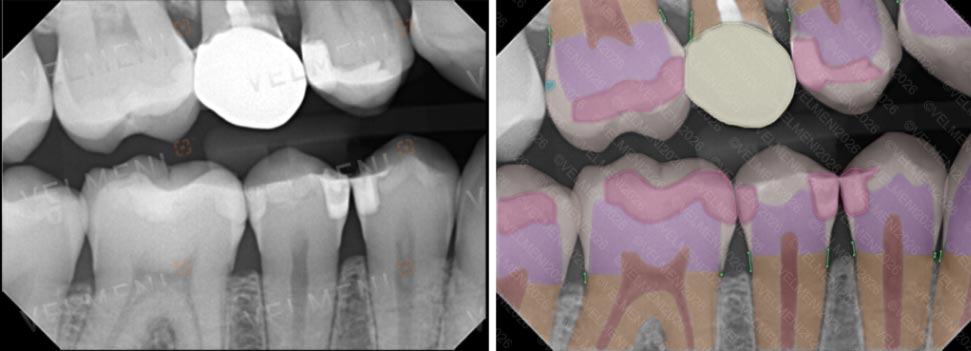
VELMENI’s AI radiographic prediction in Figure 1:
- Detected incipient caries on #3 as a blue color visual that can be missed by the human eye.
- # 3,5,28,29,30,31 – Filling/restoration predicted in pink.
- Bone level measurements <2mm highlighted in green color.
VELMENI’s client views:
After implementing VELMENI at Beaches Dentistry, Dr. Nodesh observed:
- 20% increase in case acceptance
- 6% revenue uplift
Challenge 2: Maintaining patient trust over time
During COVID, I was shadowing a dentist in New Jersey when a patient walked into the office visibly upset.
“Hey Dr. Shah, I visit you twice a year. Why didn’t you tell me I had a cavity during my last visit?”
The dentist had done everything correctly. The cavity simply wasn’t present — or wasn’t detectable — during the patient’s previous appointment. Yet the challenge wasn’t the diagnosis; it was rebuilding the patient’s trust.
The dentist had to pull up past records, compare X-rays, explain the progression of the condition, and reassure the patient that nothing had been missed. What should have been a straightforward conversation turned into a lengthy discussion.
The AI solution: Side-by-side comparison of current and historical radiographs
VELMENI enables side-by-side comparison of current and historical radiographs, automatically highlighting new findings and changes over time.
For dentists, this means spending less time searching through records and more time focusing on patient care. For patients, the visual comparison clearly demonstrates what has changed since their last visit, helping them understand why a condition may not have been present or visible before.
The result is faster conversations, improved transparency, and stronger patient trust — all within minutes.
Beyond 2D: The 3D frontier
Challenge 3: CBCT quality assurance
CBCT scans generate hundreds of image slices, making them time-consuming to review.
As a prosthodontist, I interpret CBCTs only as needed for my specialty — a challenge shared by many general dentists and specialists. Unlike oral radiologists, most clinicians are not trained to identify every artifact or scan-quality issue.
As a result, there is often uncertainty about whether a scan is diagnostically correct or whether a retake is needed. Recalling a patient for another CBCT means additional inconvenience, delays, and unnecessary radiation exposure.
The AI solution
VELMENI’s AI reviews CBCT scans within minutes and automatically identifies quality issues, artifacts, and potential retake requirements while the patient is still in the chair.
This enables dentists to make immediate decisions, avoid unnecessary patient recalls, reduce workflow disruptions, and ensure that every CBCT scan is clinically usable from the start.
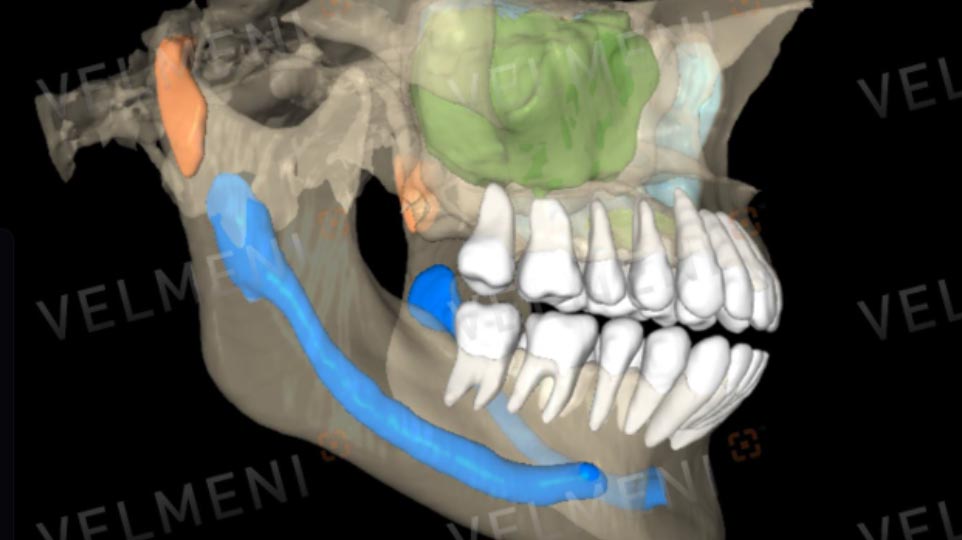
Also, colour coded visuals in a CBCT helps a dentist to explain to the patients about conditions like sinus pathology or a sinus lift required during implant cases (Figure 2).
Fig. 2
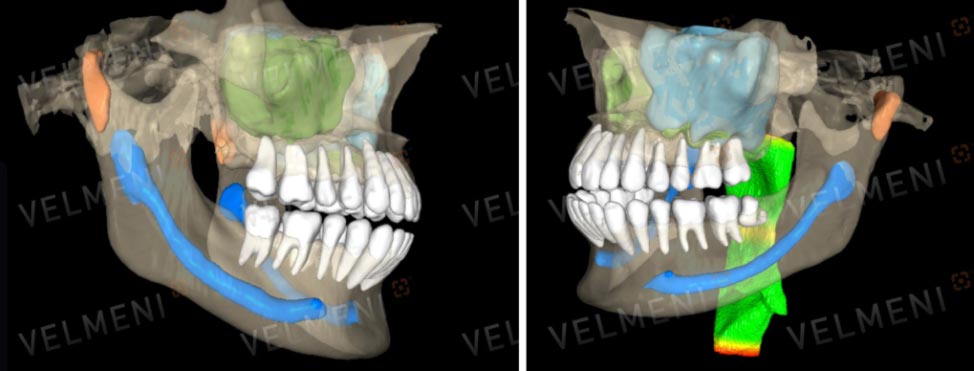
VELMENI’s AI analyzes:
- Mandibular canal in blue.
- Green color sinus highlights pathology in the sinus, thus helping the dentists explain the proximity of the tooth to the sinus.
- Blue color sinus indicates a healthy sinus.
- AI also annotated the airways and can also predict volumes in different areas.
The human element remains central
It’s important to emphasize: AI does not replace the dentist. Every finding flagged by the algorithm is reviewed, accepted, or rejected by the clinician. The dentist remains the decision-maker. AI simply ensures that nothing slips through the cracks, giving practitioners the confidence that their diagnoses are thorough and well-supported.
As dental AI becomes more widely adopted — already present in over 500 practices across 50+ countries — we’re witnessing a shift toward proactive, precision-driven care. Dentists who embrace these tools aren’t just improving their diagnostic accuracy; they’re elevating the patient experience and future-proofing their practices.
The era of squinting at shadows is ending. With AI by their side, dentists can see more, catch more, and do more — all while keeping patients smiling.
About the authors
 Dr. Alan Friedel, Chief Dental Officer Velmeni Inc., Clinical Program Director, Florida Institute for Advanced Dental Education, Dental Coding Consultant Faculty, Florida Institute for Advanced Dental Education.
 Dr. Vidhi Shah is a prosthodontist with a master’s degree in information technology and a Business Analyst at VELMENI. She is passionate about combining dentistry and technology to improve clinical workflows and advance innovation in the dental industry.