Introduction: The wrong question
Artificial intelligence (AI) is rapidly transforming dental practice. From radiographic interpretation to risk prediction and treatment planning, AI systems are increasingly embedded within routine clinical workflows.
Yet, the dominant question often posed—whether AI will replace dentists—is ultimately misleading. The real transformation lies elsewhere. AI is not replacing dentists; it is reshaping the very nature of clinical responsibility.
The dentist of the future will not compete with machines but will work alongside them, navigating an increasingly complex decision-making environment where human judgement remains central.
From operator to decision-maker
Traditionally, dentistry has been grounded in technical skill supported by clinical judgement. Dentists examine, diagnose, and perform procedures based on experience and evidence.
Today, AI systems assist in detecting caries, identifying periodontal disease, analysing radiographs, and even simulating orthodontic outcomes. These tools do not replace clinical decision-making—but they increasingly influence it.
As a result, the clinician’s role is shifting from procedural execution to high-level interpretation. The dentist becomes a decision-maker within a technologically augmented system, where understanding context is as important as performing treatment.
The new responsibility: judging the machine
With AI integration comes a new responsibility: evaluating the reliability of algorithmic outputs.
Clinicians must now consider:
- The quality and completeness of input data
- The population on which the algorithm was trained
- The presence of bias or uncertainty
- Whether the recommendation aligns with clinical findings
This layer of judgement did not previously exist. It requires dentists to critically assess not only patients, but also the tools used to evaluate them.
The risk of automation bias
Automation bias—the tendency to over-trust machine outputs—is a growing concern in AI-supported healthcare.
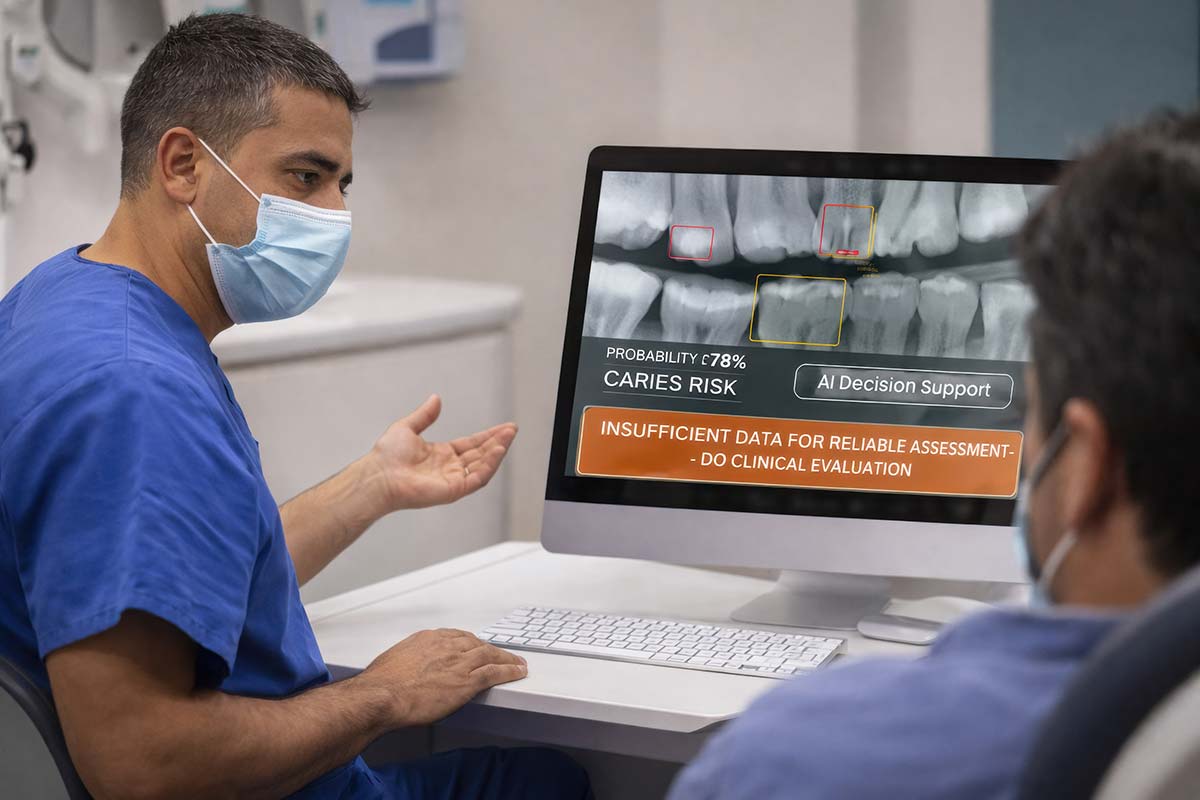
In dental practice, even subtle visual cues, such as highlighted lesions on radiographs, can influence decision-making. Clinicians may unconsciously accept AI suggestions, particularly under time pressure.
This can lead to overtreatment, missed diagnoses, or reduced critical thinking. Ironically, the more accurate AI becomes, the greater the risk that clinicians may rely on it without sufficient scrutiny.
Clinical reality: where responsibility is tested
The true challenge of AI emerges in real clinical scenarios.
Consider a radiograph with slight artefacts. An AI system may still generate diagnostic probabilities. The clinician must determine whether these outputs are valid or misleading.
Similarly, implant planning systems may suggest optimal positioning based on digital simulations, yet fail to incorporate systemic health, patient behaviour, or surgical variability.
In each case, AI provides information—but responsibility for interpretation remains entirely with the clinician.
Redefining competence in the AI era
Competence in dentistry is evolving.
In addition to traditional clinical skills, dentists must now:
- Understand how AI systems function
- Recognise their limitations
- Identify uncertainty and bias
- Communicate AI-assisted decisions transparently
This does not require deep technical expertise, but it does require a new form of literacy—AI literacy. Without it, clinicians risk misinterpreting or over-relying on algorithmic outputs.
Designing safer AI systems
Responsibility must also be embedded within AI design.
Current systems prioritise accuracy but often lack mechanisms to communicate uncertainty. Future AI tools should:
- Indicate confidence levels
- Detect out-of-scope data
- Provide explainable outputs
- Encourage clinician oversight
The goal is not to create systems that always provide answers, but systems that recognise when they should remain uncertain or silent.
Ethics: responsibility cannot be delegated
At its core, the integration of AI raises an essential ethical question: who is responsible for patient outcomes?
Despite technological advancement, responsibility cannot be transferred to algorithms. The clinician remains accountable for diagnosis, treatment planning, and patient care.
This reflects fundamental ethical principles—beneficence, non-maleficence, autonomy, and justice—which remain unchanged in the digital age.
Conclusion: A profession redefined, not replaced
Artificial intelligence is not replacing dentists. It is redefining their role.
The future dentist will operate at the intersection of clinical expertise and technological insight. Success will depend not on how much AI is used, but on how effectively it is evaluated.
In this evolving landscape, clinical responsibility becomes the defining skill of modern dentistry. And ultimately, the responsibility for patient care will always remain human.
References
- Schwendicke F, Samek W, Krois J. Artificial intelligence in dentistry: chances and challenges. J Dent Res. 2020;99(7):769–774.
- Topol EJ. High-performance medicine: the convergence of human and artificial intelligence. Nat Med. 2019;25:44–56.
- Esteva A, et al. A guide to deep learning in healthcare. Nat Med. 2019;25:24–29.
- NHS England. Artificial Intelligence in Health and Care: Policy framework. 2023.
- World Health Organization. Ethics and Governance of Artificial Intelligence for Health. 2021.
About the author
 Dr. Ameed Khalid Abdul-Hamid is an Iraqi–British dental surgeon and academic researcher, internationally recognized for his contributions to artificial intelligence in dentistry and healthcare. He holds advanced qualifications from the University of Baghdad and the University of London, and is a Fellow of the Royal College of Surgeons (UK). Dr. Abdul-Hamid serves as Chairman of the Arab Organisation for Artificial Intelligence in Healthcare and Chairman of the Saudi-British Medical Forum (London). His research focuses on AI-enabled diagnostics, digital health systems, and the ethical, responsible integration of artificial intelligence in clinical care. In 2025, his work in dental artificial intelligence was published in the British Dental Journal, and he is a recipient of the Alan Turing Award in Dental Artificial Intelligence.