
The brain doesn’t resist AI. It resists uncertainty.
Every time I speak about AI, someone inevitably says, “People are resistant to change.”
I always smile because I don’t believe that’s true.
Human beings aren’t wired to resist change. We adapt every day. We upgrade our phones, learn new software, change jobs, move across the country, and reinvent ourselves more often than we realize.
What our brains resist is uncertainty.
The moment we can’t predict what’s coming next, our nervous system begins scanning for danger instead of possibility. That’s not a character flaw. It’s neuroscience.
Understanding that distinction changes everything about how we lead.
As artificial intelligence reshapes healthcare at an unprecedented pace, organizations are investing millions in technology, training, and implementation. Yet many of those initiatives stall for one simple reason. Leaders focus on teaching people how to use AI before helping them understand how to navigate the uncertainty it creates.
Technology isn’t the greatest challenge. The human brain is.
The brain is designed to keep us safe. It constantly predicts what will happen next based on previous experiences. When those predictions no longer work, whether because of a new technology, a changing workflow, or a rapidly evolving industry, the brain experiences what neuroscientists call a “prediction error.” The result is often hesitation, skepticism, or fear.
Those reactions aren’t signs that people are unwilling to learn. They’re signs that their nervous system is trying to restore certainty. Although uncertainty is also a human need, it can create a reaction that causes people to shrink from their own potential.
That’s why facts alone rarely change minds.
You can’t coach someone out of fear simply by giving them more information.
When uncertainty is high, the emotional centers of the brain become more active while the areas responsible for creativity, problem-solving, and sound decision-making become less available. Until people feel psychologically safe, they struggle to access the very thinking leaders are asking them to demonstrate.
This is where leadership changes everything.
I’ve come to believe that the future belongs to leaders who understand one simple truth:
Influence must come before innovation.
Technology may change overnight. Human trust does not.
That’s why I use what I call the Influence Before Innovation Model, a simple framework for helping people move through uncertainty with confidence instead of fear.
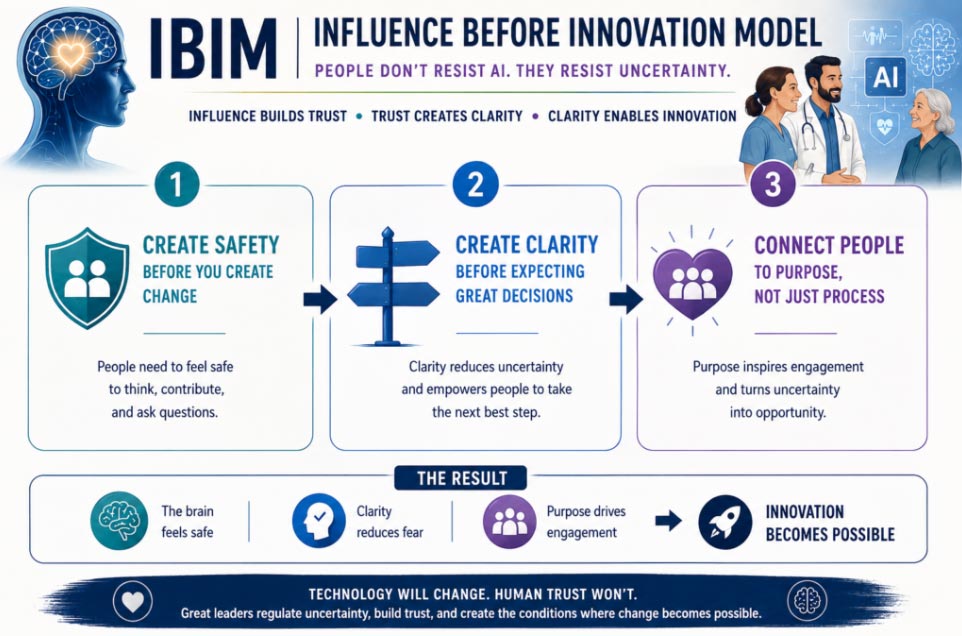
Influence Before Innovation Model
- Create safety before you create changePeople don’t perform at their best when they feel threatened. They perform at their best when they feel safe enough to think, contribute, and ask questions.Psychological safety doesn’t mean lowering expectations. It means creating an environment where learning is valued more than appearing perfect.
Leaders often underestimate the power of saying, “We’re learning this together.” That simple shift transforms uncertainty from something to survive into something to explore. When people stop protecting themselves, they start engaging.
- Create clarity before expecting great decisionsThe brain loves certainty because certainty conserves energy.When expectations are unclear, people naturally default to old habits. Not because they’re unwilling to change, but because familiarity feels safer than ambiguity.
Great leaders reduce unnecessary cognitive overload by answering three simple questions:
- Why does this matter?
- What does success look like?
- What is the next best step?
People don’t need every answer before moving forward. They simply need enough clarity and simple systems to take the next step with confidence. This means creating conditions for people to be able to move forward easily in the moments they are expected to make decisions.
Progress creates confidence far more effectively than perfection.
- Connect people to purpose, not just processAI is a remarkable tool, but people aren’t inspired by tools. They’re inspired by meaning.Healthcare has always been rooted in human connection. AI should strengthen that mission, not replace it. When leaders focus exclusively on software, workflows, and efficiency, they unintentionally create emotional distance. When they remind people that technology gives them more time to think, connect, care, and solve meaningful problems, everything changes.
Purpose quiets fear because it gives uncertainty somewhere to go. People willingly embrace change when they understand the greater impact of that change.
The organizations that will thrive in the AI era won’t necessarily have the most advanced technology. They’ll have leaders who know how to regulate uncertainty before trying to manage performance. They’ll recognize that influence isn’t about convincing people to change. It’s about creating the conditions where change becomes possible. That’s a profoundly human skill.
AI will continue to become faster, smarter, and more capable. The real competitive advantage won’t be artificial intelligence. It will be emotional intelligence, differentiation, and ease of adoption. It will be leaders who understand how the brain responds to uncertainty and who know how to transform fear into curiosity, confusion into clarity, and resistance into momentum.
The future of healthcare will absolutely be shaped by technology. But it will be led by people.
People who know how to build trust. People who know how to create certainty without pretending to have every answer. People who understand that the most advanced technology in the world will never replace a leader who can inspire confidence, cultivate resilience, and bring out the very best in others.
Because in the end, the brain doesn’t resist AI. It resists uncertainty.
And that’s exactly where great leadership begins.
About the author
 Julieanne O’Connor is a TEDx Speaker and neuroscience-based leadership strategist who partners with physicians, dentists, healthcare executives, and organizations to accelerate leadership, strengthen team performance, and guide successful transformation through human-centered influence.