
I am an oral and maxillofacial surgeon in Tirana, Albania. My clinic, DemiraqiDental, is a dental day hospital: six dental operatories, a facial aesthetics room, a surgical theatre, 3D CBCT imaging, a clinical laboratory, and blood-exam facilities. I am not an IT professional and have never worked in technology — yet over the past year, I built and now operate a fully local artificial intelligence system for this clinic, running entirely on hardware in the building, with no patient data ever leaving it. No IT department was involved, because there is none: one surgeon, evenings, and a workstation.
I am writing not to present results — those will follow in a formal publication — but to share four observations that I believe matter to any colleague considering AI in their practice.
First: the barrier is lower than advertised, but not where you expect it. The prevailing assumption is that clinical AI requires cloud subscriptions, vendors, and an IT department. It does not. Open-source language models, speech recognition, and retrieval systems can run on a workstation a clinic can afford — the decisive components being the graphics card and enough power supply, not the processors or memory that dominate enterprise pricing, needed but not mandatory. My most consequential hardware purchase was a refurbished gaming GPU. What the brochures never mention is where the real cost lives: time. Weeks of evenings spent debugging, learning, failing, and documenting. The technology is accessible; the patience is the investment.
Second: for those of us practicing outside the major languages, local AI is not a preference — it is often the only honest option. Albanian is a low-resource language. Commercial AI products are rarely evaluated in it, and their quality in it is rarely disclosed. Running models locally allowed me to test, in my own language, with my own clinical vocabulary, as a native speaker and specialist — and to reject what failed. The clinic’s assistant now answers patients’ questions about procedures, hours, and appointments in Albanian, over the messaging platform they already use, grounded in documents I wrote and reviewed myself. Every AI-generated clinical text in my practice remains a draft until a doctor has reviewed it. That rule is not negotiable, and I would urge it on every colleague.
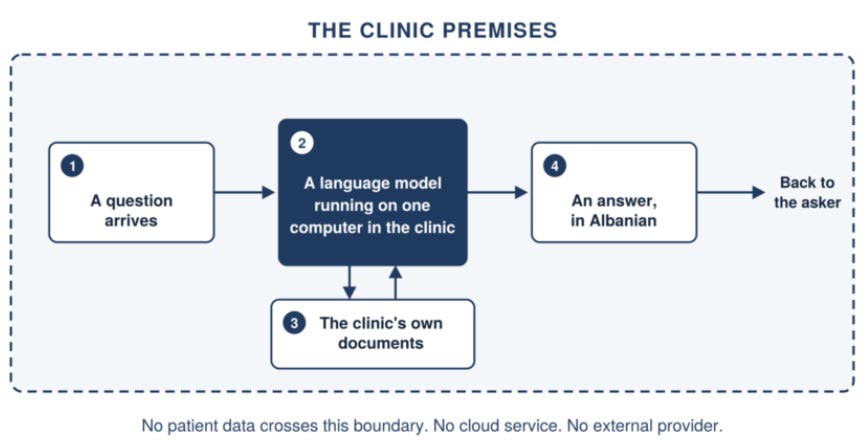
Clinic AI flow
Third: data sovereignty turned out to be the strongest argument, not the afterthought. Under European data-protection expectations, the simplest compliance posture a small practice can hold is also the most radical one: the data never leaves. No processing agreements with AI vendors, no transatlantic transfers, no wondering what a provider logs. For a private clinic without an IT department, “local” converts a legal question into an architectural fact.
Fourth: working safely with AI as a non-programmer required inventing rules — and writing everything down. Early on, every session with an AI assistant started from zero: screenshots, photographs of screens, re-explaining the whole system. Over time this evolved into a discipline: a versioned file of permanent working rules (evidence before conclusions; every command labeled as read-only or system-changing; one step at a time, verified), and a short, structured summary written at the end of each working session that the next session reads first. The effect was dramatic — hours of re-explanation collapsed into minutes, and mistakes stopped repeating. The rules themselves evolved the way clinical protocols do: each failure produced a written amendment. I now believe this documentation habit, not any particular software, is what makes AI genuinely usable by a clinician working without technical staff.
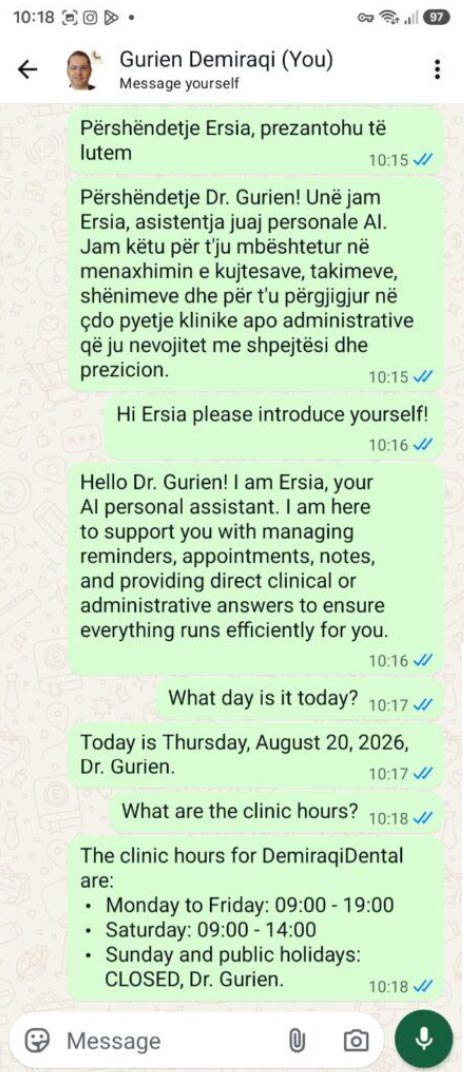 I went into this with larger dreams — digital avatars presenting in Albanian, ambient clinical documentation, an AI greeter at the front desk. A year ago, these sounded like fantasy for a private clinic without an IT department; today, the avatar pipeline works end-to-end on my own hardware, and the front-desk touchscreen is reality. What runs in production now — a private assistant that speaks my patients’ language, on my infrastructure, on my terms — turned out to be only the beginning.
A detailed technical and methodological account — hardware, costs, failures included, and the governance rules I developed to work safely with AI agents as a non-programmer — is in preparation for submission to an indexed journal. I share this letter in the meantime because I suspect there are many clinicians like me: curious, unfunded, and told that this is not for them. It is.
One final disclosure, offered with a smile: this letter itself was drafted in collaboration with one of the frontier AI assistants — the same class of agentic tools that built the clinic’s system with me. It seemed only fair to let the subject of the story help write it.
About the author
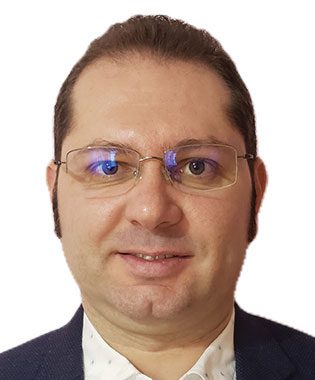 Dr. Gurien Demiraqi is Professor and Head, Oral-Maxillofacial Surgery, Faculty of Med Sciences, Albanian University, Visiting Professor, Universal School of Health, University of California Albanian President, International Academy of Implantoprosthesis and Osteoconnection (IAIO). He is the Inventor, Sticky Tooth grafting material and co-inventor of the Baruti-Demiraqi approach Awarded.