
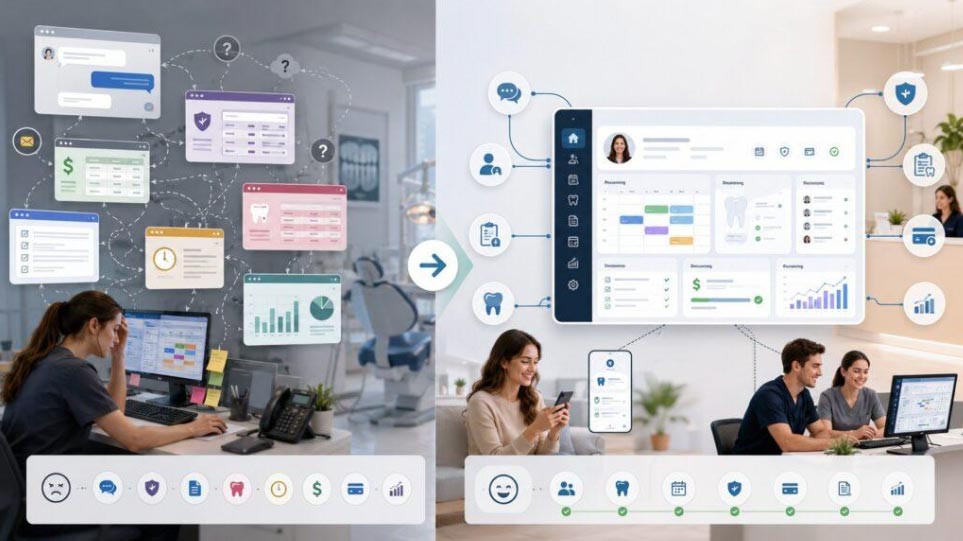
What a live audit of my practice revealed about Isaac, Trust AI’s practice-management platform, operational leakage, and the future of AI-enabled dental workflows.
A modern dental PMS should do more than store charts, schedules, and ledgers. It should help the practice identify leakage, prioritize action, protect chair time, strengthen recare, and make the business side of dentistry more visible without disrupting patient care.
The fear of switching is real
For nearly 20 years, I have practiced dentistry through the same technology evolution many dentists have experienced: from off-the-shelf software to server-based systems, to cloud and internet-based workflows, and now toward AI-enabled operational platforms.
Each generation promised improvement. Some improvements were real, yet the practical burden on the dental office often remained familiar: multiple systems, multiple logins, fragmented workflows, recurring administrative workarounds, and the persistent concern that a major transition could disrupt patient care, billing, scheduling, claims, communication, or staff coordination.
That concern is rational. A dental office has very little room for operational instability. We cannot afford missed patients, broken schedules, lost data, interrupted billing, confused staff, or weeks of uncertainty. For that reason, many dentists tolerate outdated systems, high monthly software expense, and fragmented workflows because the idea of switching feels more dangerous than staying put.
Who we are, and why the decision mattered
I am the founder of Desert Dream Dentistry & Spa in Palm Desert, California. Our office is a comprehensive, high-technology, community-trusted dental practice with multiple dentists and specialists involved in patient care.
We provide care across general dentistry, cosmetic dentistry, implant dentistry, oral surgery, diagnostics, restorative care, and comprehensive treatment planning. Our patients expect consistency, access, communication, and clinical coordination at a high level.
That context matters. A practice like ours depends on operational continuity. The front desk, back office, clinical team, billing workflows, insurance coordination, treatment communication, scheduling, payments, follow-up, and patient experience all have to work together. When those systems do not communicate effectively, the cost is not merely financial. It becomes a staff burden, a patient-experience issue, and a management risk.

Desert Dream Dentistry & Spa in Palm Desert, California: a high-technology dental practice where clinical care, patient experience, and operational systems must work together without disruption.
What changed my view
My view began to change during our transition to Isaac, Trust AI’s AI-native practice-management platform. The most important factor was not only the software. It was the implementation experience itself.
Trust AI had a transition model that was materially different from what I expected. Our full integration and data transfer took approximately two weeks. During that period, business operations continued. Training occurred in parallel. The office remained functional. The team was supported. Most importantly, nothing was lost.
Instead of feeling like a disruptive PMS conversion, the transition felt more like a carefully managed operational upgrade. We continued seeing patients while the system was implemented, the data was transferred, and the staff was trained. That level of continuity matters because it removes one of the largest psychological and practical barriers dentists face when considering a platform change.
The economics of fragmentation are larger than subscription cost
The first economic question was simple: could a lower base subscription price and consolidated functionality reduce software overhead? That question mattered, and it still matters. Modern dental offices often operate with a patchwork of subscriptions: one system for the PMS, another for communication, another for insurance breakdowns, another for claims submission, another for forms, another for payments, another for analytics, and another for patient engagement.
A lower base cost is useful only if it is paired with operational value. In our case, the approximately $299 monthly base price, combined with consolidated functionality and visibility we did not previously have in one place, made the decision more compelling.
But the audit changed the conversation. It showed that the larger economic issue was not only what we were paying for software. It was what fragmented systems had failed to surface inside the practice: diagnosed treatment not scheduled, recare not configured, patients not reappointed, balances not separated into actionable and non-actionable categories, and cancellations not treated as an operational risk category.
What the audit revealed in our own practice
After migration, we ran a practice performance audit against our own data for the past approximately 10 years. This is where the analysis moved from anticipated savings to practice-specific findings. The audit was not a generic sales model. It was a baseline review of our own production, scheduling, recare, treatment planning, patient-pay collections, and data-quality issues.
With appropriate limitations understood, the findings were material. On a trailing-12-month production base of approximately $1.91 million, the audit identified roughly $1.0 to $1.3 million per year of recoverable or at-risk production in areas we were not actively working in a systematic way.
The largest category was unscheduled treatment. The audit identified approximately $2,156,282 in planned treatment across 674 patients and 4,170 procedures that had been diagnosed and treatment-planned but not scheduled or completed. Implant services alone represented $846,735 across 951 procedures, roughly 39% of the backlog. Restorative care, fixed prosthodontics, endodontics, oral surgery, and other categories made up the balance.
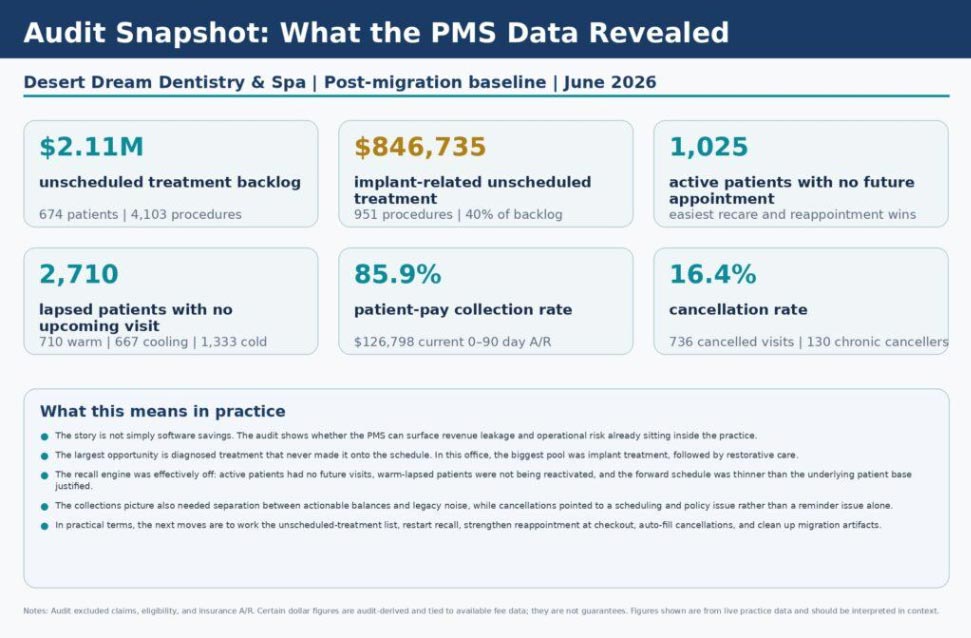
Audit-derived findings from Desert Dream Dentistry & Spa, shown as aggregate operational categories rather than patient-level details.
The schedule was telling us something
The audit also made the schedule easier to understand. We had 1,025 active patients who had been seen within 18 months but had no future appointment. We also had 2,710 lapsed patients with no upcoming visit: 710 warm patients last seen within 6 to 18 months, 667 cooling patients last seen within 18 to 36 months, and 1,333 cold patients last seen more than 36 months earlier.
At the same time, recall tracking was not configured. That is a critical finding because recall is one of the most basic engines of practice continuity. If recall is not properly configured and patients are not consistently reappointed before leaving, the schedule becomes dependent on human memory, manual effort, and reactive outreach.
The forward schedule confirmed the concern. The audit found 543 future appointments across 499 patients, with 141 appointments in the next 30 days. For a practice that had seen 1,190 patients in the prior year, that suggested the schedule was underfilled relative to the demand already present in the chart.
Collections and cancellations were also workflow problems
Collections were another example of why the PMS conversation cannot be limited to charts and schedules. The audit showed trailing-12-month production of $1,907,129 and collections of $1,638,528, which represented an 85.9% patient-pay collection rate. It also identified approximately $126,798 in current 0-90 day A/R that was actionable now.
The audit was careful not to overstate the A/R picture. Total patient A/R appeared to exceed $2 million, but 92% was more than 90 days old and much of it appeared to be legacy or migration artifact rather than immediately collectible money. That distinction is important. A modern system should not merely show a large number; it should help the practice separate actionable balances from data noise.
Cancellations added another layer. The audit showed a 16.4% cancellation rate over the prior 12 months, with 736 cancelled visits out of approximately 4,487 booked visits. It also identified 130 chronic-cancellation patients. Reducing cancellations to a healthier range could free approximately 380 visit slots per year. That is not just a reporting issue. That is chair time, staffing efficiency, revenue continuity, and patient access.
Why this is different from a traditional PMS report
Traditional PMS reports can be useful, but in many practices they are difficult to run, difficult to interpret, and too disconnected from daily action. A report that sits in a menu does not change behavior. A dashboard that is not tied to team workflow does not automatically improve the schedule. A number that is not connected to outreach, recall, collections, or follow-up is still only a number.
What made the Isaac experience different was the way the audit converted practice data into specific action categories. It did not simply say that there was unscheduled treatment. It identified the size of the backlog, the patient pool, the procedure mix, and the categories of work that should be prioritized. It did not simply say recare was weak. It separated active-no-future patients from warm, cooling, and cold lapsed patients. It did not simply show A/R. It separated current actionable balances from likely legacy artifacts.
That is the meaningful shift: from a system of record to a system of action. A system of record stores what happened. A system of action helps the practice decide what should happen next. And once the practice gives the green light, the platform does not stop at the recommendation. It runs the work itself: personalized outreach to unscheduled and lapsed patients, recall configured and managed, and the backlog worked systematically. The practice decides what to pursue; the system carries it out.
How this should translate into the practice
For our office, the practical translation is straightforward. First, work the unscheduled-treatment backlog systematically, beginning with the highest-value diagnosed treatment and the patients most likely to proceed with care. Second, restart the recare engine by configuring recall and segmenting patients based on recency of contact. Third, improve the forward schedule by making reappointment before checkout a disciplined operating standard.
Fourth, address cancellations as a defined risk category rather than a daily annoyance. Chronic cancellers should be identified, confirmed differently, and, where appropriate, managed with deposits or policies that protect chair time. Fifth, clean the data. Migration artifacts, duplicate treatment plans, and questionable large balances must be reviewed so reports become more reliable over time.
One practical change was immediate: our front office and clinical team began asking Isaac more targeted questions each day, using the audit to identify patients with unscheduled treatment, no future appointment, or recall gaps. Instead of waiting for a report to be pulled at month-end, the staff now locates those patient groups in Isaac, verifies what is actionable, and follows up in a more organized way. That has changed the daily workflow from passive reporting to active patient-specific outreach.
Those steps are not glamorous, but they are exactly where dental practices often win or lose profitability. The technology matters because it can make these loops visible and repeatable. The doctor and team still have to lead the process, but the system should make the right work easier to find and easier to act on.
What dentists should take from this
I would not present my practice audit as a universal promise for every office. Every practice has different contracts, patient volume, staffing, payer mix, clinical mix, fee schedule, data quality, and operational discipline. Dentists should be skeptical of any technology claim that sounds automatic or guaranteed.
But I would strongly encourage dentists to ask a different question of their practice-management systems. The question is no longer only, “Can this software store my schedule, chart, ledger, and claims?” The better question is: “Can this platform help me see what my practice is missing, prioritize what is actionable, and support my team in closing the loop?”
That is where Isaac changed my thinking. It was not merely the transition. It was not merely a lower base cost. It was not merely the possibility of reducing software subscriptions. It was the combination of implementation support, consolidated functionality, AI-enabled visibility, and practice-specific action intelligence.
A call for due diligence, not blind adoption
This article is not intended as a blanket recommendation that every dentist immediately change systems. Every office should conduct its own due diligence. Dentists should carefully review data-migration protocols, cybersecurity and HIPAA-related safeguards, support commitments, contract terms, integration options, billing implications, claims workflows, staff-training plans, reporting capabilities, AI-related functions, and exit rights before making any transition.
But dentists should also stop treating fear as a substitute for analysis. The old world of dental software made switching feel dangerous. A better implementation model, a more connected platform, and a serious audit of what is already happening inside the practice can make the decision far more rational.
For my practice, Isaac became more than a PMS replacement. It became a foundation for a different way of looking at dental operations. The next frontier is not simply replacing one software vendor with another. It is building a modern dental operating environment around the practice: the PMS as the backbone, supported by intelligent workflows that improve patient experience, front-office coordination, clinical communication, administrative visibility, revenue recovery, and doctor oversight.
Practice-specific findings used in this article
| Audit category | Practice-specific finding |
|---|---|
| Trailing-12-month production base | ~$1,907,129 (~$159K/month) |
| Unscheduled treatment backlog | $2,156,282 across 674 patients and 4,170 procedures |
| Implant-related unscheduled treatment | $846,735 across 951 procedures |
| Active patients with no future appointment | 1,025 |
| Lapsed patients with no upcoming visit | 2,710 total: 710 warm, 667 cooling, 1,333 cold |
| Forward schedule | 543 future appointments across 499 patients; 141 in next 30 days |
| Patient-pay collection rate | 85.9%; current actionable 0-90 day A/R approximately $126,798 |
| Cancellation rate | 16.4%; 736 cancelled visits; 130 chronic-cancellation patients |
About the author
 Dr. Kianor Shah, DMD, MBA, is a practicing dentist, inventor, and healthcare entrepreneur based in Palm Desert, California. He is the founder of Desert Dream Dentistry & Spa and Global Summits Institute. His work focuses on clinical dentistry, healthcare innovation, practice operations, and doctor-to-doctor collaboration.