Artificial Intelligence (AI) is rapidly reshaping dental practice as it is increasingly integrated into everyday clinical workflows. Avoidance of AI, whether due to hesitation or reluctance, is ultimately incompatible with successful practice. The underlying fear is that artificial intelligence may replace the clinician in the delivery of care; in reality AI functions as an advanced diagnostic adjunct, analogous to established technologies such as radiography, intraoral cameras, and cone-beam imaging.
Dentistry has traditionally relied on technical expertise guided by clinical judgment honed by years of training, with practitioners examining, diagnosing, and treating patients based on both evidence and experience. Artificial intelligence now supports a wide range of functions, including caries detection, periodontal assessment, radiographic interpretation, implant planning, and simulation of orthodontic outcomes. While these technologies do not replace clinical decision-making, they are exerting an increasingly significant influence in shaping it. Consequently, the clinician’s role is evolving from one centered primarily on procedural execution to one that emphasizes higher-level interpretation of complex data. The modern dentist functions as a decision-maker within a technologically augmented environment, where contextual understanding is as critical as technical execution.
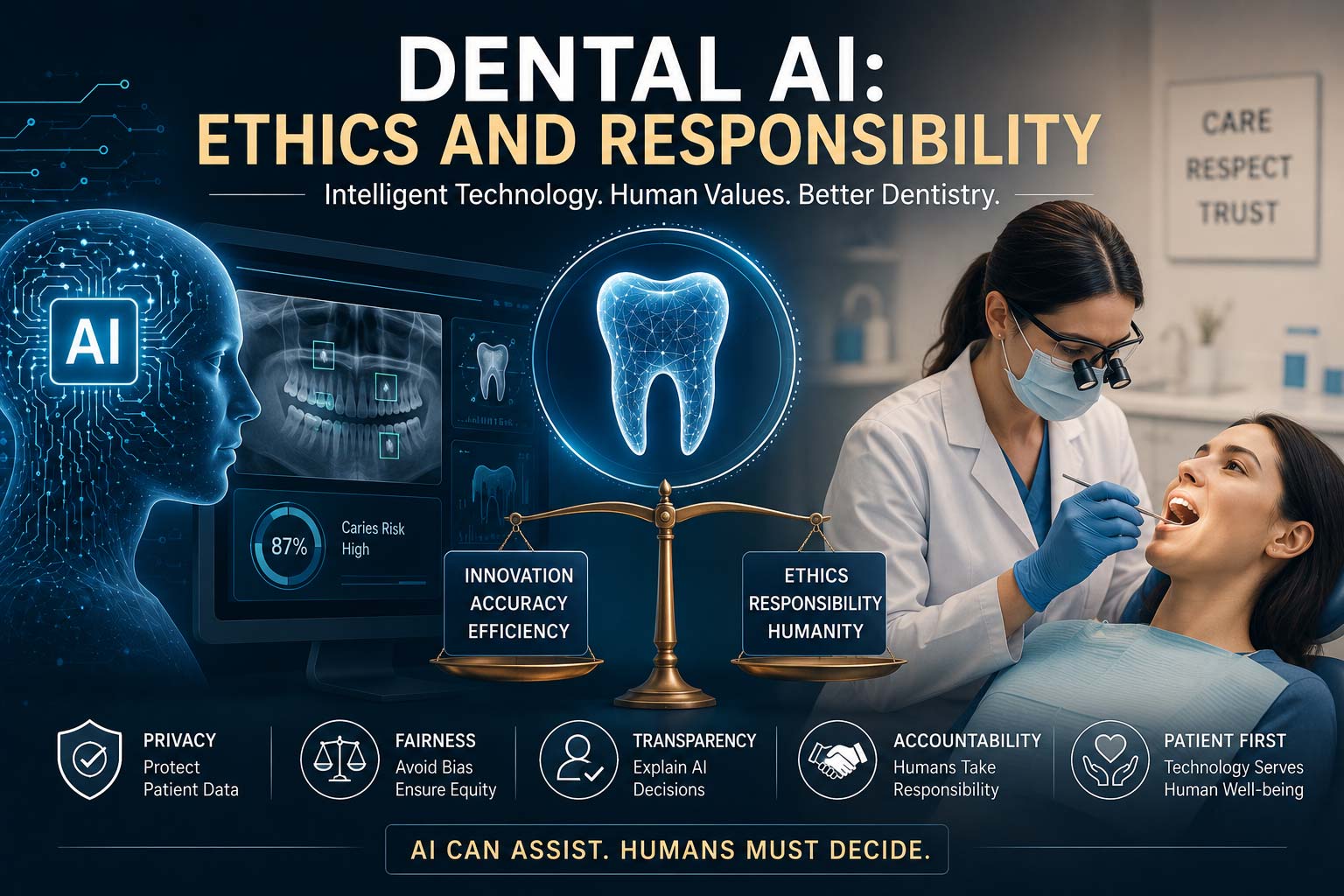
The integration of artificial intelligence introduces an additional layer of professional responsibility: the critical appraisal of algorithmic outputs. Clinicians must assess factors such as the quality and completeness of input data, the populations on which algorithms are trained, the potential for bias or uncertainty, and the extent to which AI-generated recommendations align with clinical findings. This expanded scope of judgment requires dentists not only to evaluate their patients but also to rigorously scrutinize the technologies informing their decisions. The clinician is the administrator and supervisor of both diagnostic processes and their supporting systems. These responsibilities must remain grounded in the core principles of medical ethics. Beneficence and non-maleficence require clinicians to prioritize patient welfare and to avoid harm, mandating critical engagement rather than passive acceptance of AI-derived recommendations. Respect for patient autonomy necessitates transparent communication regarding the role of AI in health care to support informed consent, while justice calls for the equitable and unbiased application of these technologies across patient populations.
Within this context, automation bias, the tendency to place undue trust in machine-generated outputs, emerges as a significant concern in AI-assisted healthcare. In dentistry, even subtle visual cues, such as AI-highlighted findings on radiographs, can influence clinical judgment, particularly under time constraints that may favor rapid acceptance over careful evaluation. Such reliance carries the risk of overtreatment, missed pathology, and diminished diagnostic scrutiny. Paradoxically, as AI systems continue to improve in accuracy, the potential for uncritical dependence may further increase.
The integration of artificial intelligence into healthcare underscores a fundamental ethical question: who bears responsibility for patient outcomes? Despite the growing role of AI, the clinician remains fully accountable for diagnosis, treatment planning, and clinical execution. Accordingly, AI should be regarded not as a substitute for clinical judgment, but as a tool to be applied thoughtfully, critically, and within established frameworks of professional responsibility.
Framing AI as a potential replacement for dentists is therefore misleading. The more substantive shift is one of transformation rather than substitution. AI is redefining, not diminishing, the clinician’s role, which increasingly centers on navigating complex, technology-enhanced decision-making environments where human judgment remains indispensable.
About the author
 George Freedman BSc, DDS, FIADFE, DiplABD, FAACD, FASDA, FPFA on behalf of the Artificial Intelligence Journal of Medicine and Dentistry (AIMEDENT Journal)
georgefreedmandds@gmail.com