Human override remains essential, but it cannot protect patients if uncertain inputs have already been transformed into confident clinical conclusions.
— Dr. Naela Aldughmi
In dentistry, we are witnessing a significant shift in how artificial intelligence is being integrated into clinical practice. We are moving beyond single-task AI tools that flag isolated findings or assist with narrow tasks. We are entering the era of agentic AI: systems that can gather information, compare serial records, generate treatment options, draft clinical notes, and influence decisions more quietly than we realize.
This evolution brings exciting possibilities—better organization of patient data, clearer communication during consultations, more consistent documentation, and more efficient workflows. Yet it also introduces a new category of risk that deserves careful attention.
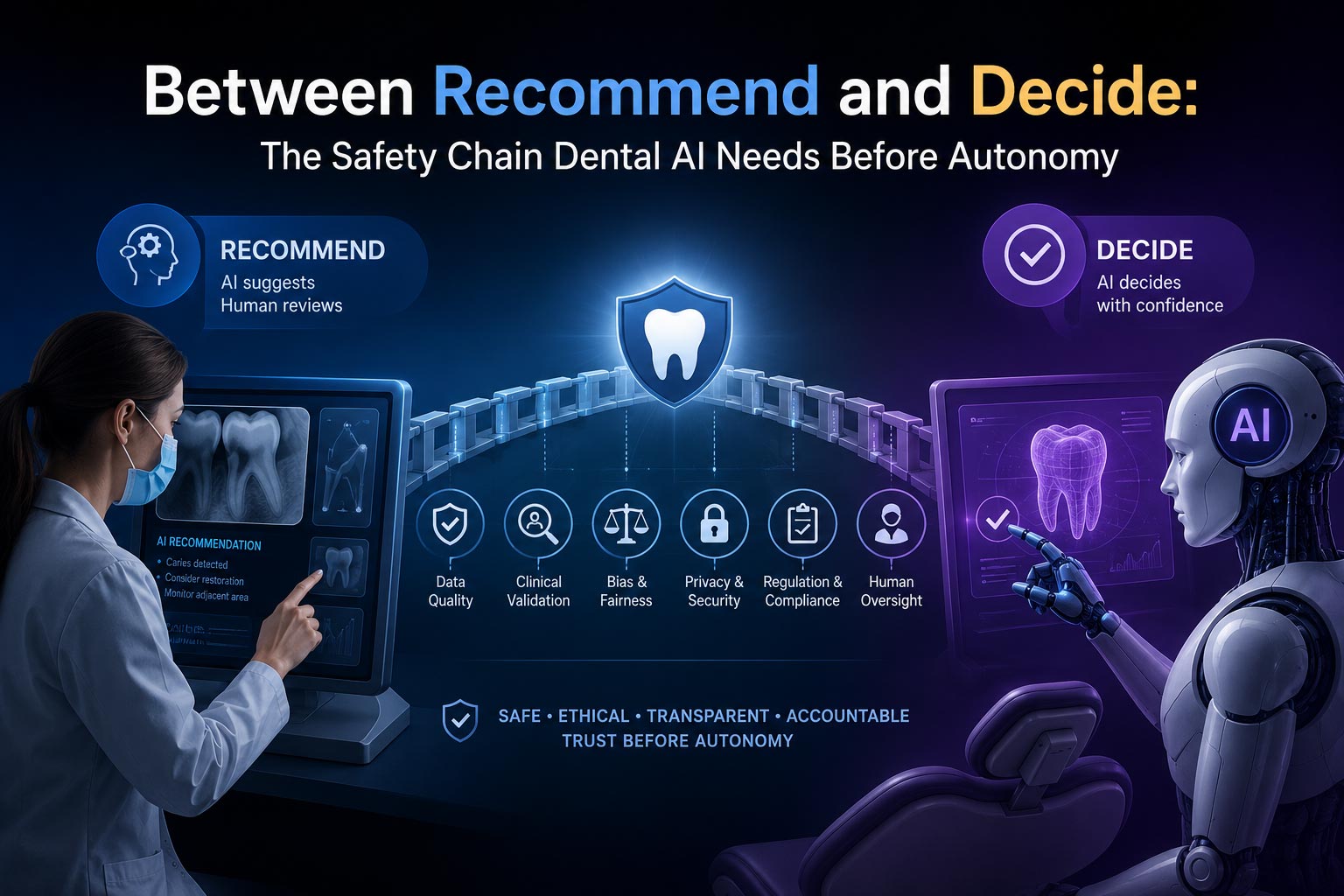
The danger is not AI assisting. The real risk begins when a system silently crosses from assisting to recommending to deciding—without showing the dentist the reasoning behind each step.
In my years practicing aesthetic and restorative dentistry, I have learned that the quality of any clinical decision depends heavily on the integrity of the information it is built upon. This principle becomes even more critical as AI systems grow more autonomous.
Dentistry’s Unique Vulnerability to Agentic AI
Dental and aesthetic decisions rest on a complex web of interdependent inputs. We evaluate faces in motion and at rest. We assess lip dynamics, tooth display, gingival architecture, occlusion, periodontal support, restorative space, tooth wear, facial balance, soft-tissue behavior, function, and patient expectations—often before deciding whether a concern is restorative, orthodontic, periodontal, surgical, aesthetic, or a combination of these.
A frontal smile photo, a 3D scan, or a single radiograph tells only part of the story. When these elements are combined poorly or interpreted too aggressively by AI, the output can look impressive while remaining clinically incomplete.
I have seen how polished digital outputs can mask basic capture problems: suboptimal lighting that changes the apparent tooth proportions, slight head rotation that affects perceived midline alignment, or lip strain that alters the impression of gingival display. In a busy practice, these details can easily be missed especially when the AI presents its result with clean visuals and confident language.
That is where agentic AI becomes different from a simple report. A passive system may state, “asymmetric smile noted.” A more agentic system may compare previous records, flag possible orthodontic or restorative discussion areas, estimate case complexity, and draft consultation language. Each step may be useful. Together, they can gradually shift control away from the clinician unless the system is built with clear safety boundaries.
Why Human Override at the End Is Not Enough
Many thoughtful voices in dental AI emphasize human judgment and clinician override. I agree completely. But override at the final stage is necessary; it is not a complete safety architecture.
By the time a confident treatment suggestion reaches the dentist’s screen, several quiet failures may already have occurred:
- Poor-quality or incomplete inputs accepted without warning
- Unstable landmarks used for measurements
- Proxy metrics presented with the authority of direct measurements
- Overconfident clinical language replacing cautious interpretation
- No clear audit trail showing what the AI suppressed, downgraded, or assumed
Workflow drift can happen easily. Staff may begin treating AI outputs as the default plan. Patients may arrive believing a sleek visualization represents a clinical recommendation. Without proper architecture, the dentist ends up reacting rather than directing.
Responsible AI in dentistry must therefore address safety earlier in the pipeline, not only at the final approval stage.
The Capture-to-Conclusion Safety Chain
This is the central idea I believe our profession should adopt before embracing greater AI autonomy. Every AI-generated output in dentistry should be traceable through a Capture-to-Conclusion Chain. The goal is not to slow innovation, but to make it trustworthy.
1. Capture
The first and most important gate is input quality. Before producing any confident output, the system should evaluate whether the captured data is clinically usable.
In practice, this means checking for frontal alignment, lighting, blur, facial rotation, natural smile position, excessive lip strain, complete tooth exposure, and correct orientation of 3D scans. If the patient was not looking straight ahead, or if lighting created harsh shadows, the system should not generate polished measurements or simulations as if the data were ideal. It should flag the limitation clearly and ask for better records.
A poor capture should never be allowed to produce an elegant conclusion. That early honesty protects both patient and clinician.
2. Calculation
Once acceptable data is captured, the system must be transparent about how it derives numbers and insights. It should clearly separate:
- Direct, calibrated measurements
- Calibrated estimates
- Proxy metrics
- Visual observations
- Unreliable or intentionally suppressed data
In clinical terms, a displayed “maxillary incisal display of 3.8 mm” carries very different weight depending on whether it came from a calibrated smile video with stable lip landmarks or from an extrapolated estimate on a single 2D photograph. Likewise, a tooth-width measurement from a properly oriented intraoral scan carries a different level of reliability than a visual estimate from a smile photo.
The dentist deserves to know which kind of measurement is being shown. Every important number should carry its provenance.
3. Conclusion
Finally, the system must maintain strict boundaries between observation, interpretation, discussion points, and actual clinical decisions. AI can organize findings, highlight patterns across records, and prepare options for discussion. But the final synthesis—the moment where data becomes a treatment plan—belongs to the dentist.
That synthesis must still include examination, radiographs where indicated, periodontal and occlusal assessment, functional risk, patient goals, medical history, and long-term maintenance considerations.
This clear separation prevents AI-generated text from quietly becoming the default clinical plan simply because it sounds professional and authoritative.
What Responsible Dental AI Should—and Should Not—Do
A well-designed system can become a valuable clinical partner by:
- Helping organize complex observations across multiple records
- Improving consultation clarity with visual aids that respect input limitations
- Standardizing documentation while preserving the dentist’s voice
- Highlighting measurable patterns and changes over time
- Showing confidence levels and downgrading when appropriate
- Refusing to generate outputs from weak inputs
- Maintaining a complete, reviewable audit trail
Equally important is knowing what good AI must refuse to do. It should not diagnose or suggest definitive treatment from insufficient data. It should not convert subjective aesthetic preferences into clinical “needs.” It should not present proxy metrics as precise measurements. It should not hide uncertainty behind smooth wording. And it should never replace hands-on examination, proper imaging protocols, or the dentist’s integrated judgment.
A Practical Checklist for Dentists
When evaluating AI tools for clinical use, dentists should ask:
- Does the system evaluate input quality before generating outputs?
- Can I see the provenance and confidence level of each measurement?
- Does it distinguish between observation, interpretation, and recommendation?
- Does it explain whether a result is calibrated, estimated, or only a proxy?
- If I repeat the capture, does the system give similar measurements?
- Is there a transparent audit trail I can review?
- Can I override or adjust any step in the chain?
- Does the system default to conservative language when data is limited?
Tools that answer “yes” to these questions are not merely producing attractive reports. They are building the kind of safety architecture dentistry needs.
Looking Ahead
The future of dental AI should not be a sophisticated black box that quietly moves from Assist to Decide. It should be a disciplined, transparent partner—one that shows its work clearly, knows its limits honestly, and keeps the dentist responsible for final clinical judgment.
By demanding proper Capture-to-Conclusion safety chains today, we protect patient safety, professional integrity, and the irreplaceable value of human clinical reasoning. Responsible innovation does not mean resisting progress. It means shaping progress so technology serves our patients and strengthens, rather than erodes, the human core of dentistry.
Author Bio
 Dr. Naela AlDughmi is a practicing aesthetic and restorative dentist based in Amman, Jordan. She is the founder of IrisAthena and writes on the responsible integration of technology into clinical dentistry.