For years, the conversation around AI in dentistry has focused on what the technology can detect, automate, or generate.
Can AI identify pathology on radiographs?
Can it automate notes?
Can it create treatment simulations?
Can it improve scheduling, billing, or recall systems?
These are meaningful advances. But they all share the same underlying assumption:
That dentistry’s primary bottleneck is producing more information.
It isn’t.
The real bottleneck is what happens to information after it is created.
In many workflows, fragmentation begins long before the patient leaves the clinic. Findings, explanations, treatment sequencing, documentation, communication, and follow-up systems often evolve separately instead of forming one continuous patient journey.
Across modern dental organizations, treatment plans are presented every day with clear clinical intent and genuine patient benefit. Yet enormous amounts of accepted treatment never become completed care. Patients delay. Follow-ups fragment. Explanations vary between providers. Documentation loses continuity. Teams spend more time recovering workflow breakdowns than preventing them.
The problem is no longer data scarcity. The problem is operational fragmentation.
The Industry Has Optimized Detection. It Has Not Optimized Continuity.
Modern practices already generate enormous amounts of clinical information:
- radiographs
- intraoral scans
- photographs
- periodontal charting
- SOAP notes
- treatment plans
- scheduling history
- communication logs
- financial records
But most of this information exists as disconnected fragments.
One system stores imaging.
Another stores notes.
Another manages communication.
Another tracks treatment acceptance.
Another tracks billing.
The result is that practices often have more data than ever — but less operational clarity.
This issue becomes especially visible in elective and comprehensive treatment workflows, where success depends not only on diagnosis, but on maintaining continuity across time.
A consultation may go extremely well. The patient is engaged. They ask questions. They appear motivated. The treatment plan makes clinical sense.
A patient may verbally accept treatment during consultation, but the workflow later fragments through delayed scheduling, unanswered questions, financing uncertainty, or inconsistent follow-up communication.
And the workflow begins to fragment.
The Decision Window Is Where Most Production Disappears
One of the most overlooked realities in dentistry is that treatment decisions are rarely finalized inside the consultation room.
They happen afterward:
- during the drive home
- in conversations with spouses or family
- while reviewing estimates later at night
- after financial anxiety appears
- after details are partially forgotten
- after confidence begins to decay
Research consistently shows that patients remember only a fraction of healthcare information after consultations. The more complex the treatment discussion, the greater the loss of recall.
This becomes highly relevant in esthetic, restorative, and multidisciplinary dentistry, where treatment acceptance depends heavily on understanding, confidence, perceived value, and emotional certainty — not merely diagnosis.
The industry has traditionally treated this as:
- a sales issue
- a financing issue
- a communication issue
But operationally, it is something else:
a continuity problem.
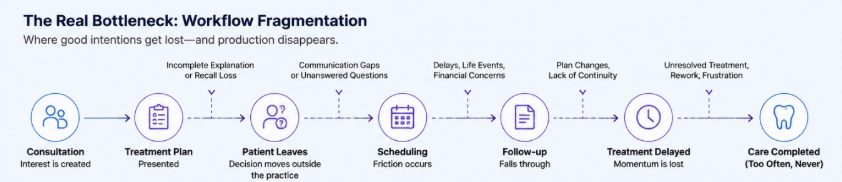
The consultation creates momentum but most workflows fail to preserve it.
Case Acceptance Is Not the Same as Case Completion
One of the most important operational insights emerging in modern dentistry is that accepted treatment does not necessarily become completed treatment.
A recent analysis of thousands of dental practices found that average case completion rates remain dramatically lower than treatment acceptance rates.
In other words:
Patients often say “yes” — but the workflow fails afterward.
This changes how we should think about operational performance.
The bottleneck is not only convincing patients to proceed. The bottleneck is maintaining continuity between:
- diagnosis
- explanation
- scheduling
- documentation
- follow-up
- long-term treatment progression
The highest-performing organizations are not simply presenting more treatment.
They are reducing workflow friction between clinical intent and completed care.
The Next Generation of AI Will Focus on Workflow Intelligence
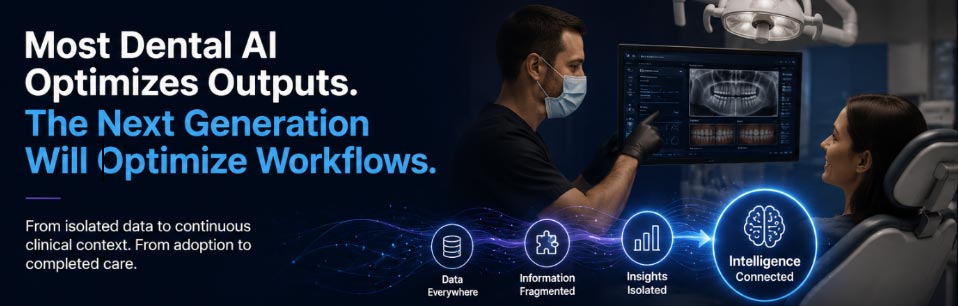
Most current AI systems in dentistry optimize outputs:
- image interpretation
- note generation
- simulation rendering
- risk scoring
- scheduling automation
The next generation will optimize workflows. This is a fundamentally different layer of intelligence.
Why This Matters for DSOs and Large Organizations
As organizations scale, operational inconsistency compounds.
This creates hidden operational volatility.
Interestingly, recent DSO operational data suggests that consistency itself may be one of the strongest predictors of sustainable growth. Organizations with stable operational patterns significantly outperform highly volatile organizations.
The implication is important:
The future competitive advantage in dentistry may not come from who detects the most findings.
It may come from who operates with the most continuity.
From Static Records to Continuous Clinical Context
Historically, dental software systems were designed primarily as:
- scheduling tools
- billing systems
- documentation repositories
But modern clinical environments increasingly require something different.
This is where workflow intelligence becomes clinically and commercially relevant.
Because continuity is not only about efficiency.
It directly affects:
- patient trust
- treatment acceptance
- scheduling predictability
- provider stress
- documentation defensibility
- operational scalability
Dentistry’s Next AI Phase Will Be Less About Automation — And More About Coordination
The first wave of dental AI focused on assistance:
- helping clinicians detect
- summarize
- automate
- visualize
The next phase will focus on coordination:
- aligning teams
- preserving treatment understanding
- reducing workflow fragmentation
- improving operational predictability
- maintaining continuity across the patient journey
This is a more difficult problem than image detection.
But it is also a more consequential one because the practices and organizations that solve continuity effectively will not simply produce more dentistry.
They will create:
- more predictable operations
- more consistent patient experiences
- more complete treatment journeys
- and ultimately, more trusted healthcare systems
Importantly, solving continuity cannot depend on adding more administrative burden to clinicians already overwhelmed by documentation and workflow complexity.
The future of dental AI may not belong to the systems that generate the most information, but to the systems that help teams maintain clarity, continuity, and patient confidence from first consultation to completed care.
About the author
 Dr. Sami Savolainen is a dentist and founder of SmileMatch, a platform focused on clinical workflow intelligence, treatment communication, and documentation continuity. Combining clinical experience with system design, he explores how operational workflows influence treatment acceptance, patient trust, consistency, and scalability in modern healthcare.